
By the WriteFlux Team · Last updated: November 5, 2026
Quick Answer
The 12 gravel types on this page are pea gravel (1/4–3/8 inch), crushed stone, crusher run/DGA (dust to 3/4 inch), #57 stone (3/4 inch, clean), river rock (1–4 inches), decomposed granite, lava rock, marble chips, slate chips, bank gravel, riprap and recycled crushed concrete. For driveways, use a compactable base (crusher run) topped with #57. Paths and patios: pea gravel or decomposed granite. Drainage: clean #57. Rounded stone never compacts — angular stone does.
“Gravel” is not one material. It is a whole shelf of materials that look similar in a pile and behave completely differently in the ground. Pick a rounded stone where an angular one was needed and your driveway migrates like a riverbed; pick a stone full of dust for a drain and the drain clogs. This guide walks through the types that matter — what each one is, what size it comes in, what it costs relative to the rest, and the job it is actually for.
Types of Gravel at a Glance
| Type | Size | Shape | Compacts? | Best for | Cost level |
|---|---|---|---|---|---|
| Pea gravel | 1/4–3/8 in | Rounded | No | Paths, patios, play areas, beds | Mid-range |
| Crushed stone (#57) | About 3/4 in | Angular | Locks, stays open | Driveway surface, French drains, drainage | Budget–mid |
| Crusher run (DGA) | Dust to 3/4 in | Angular with fines | Yes — packs hard | Driveway and paver bases | Budget |
| #3 stone | 1–2 in | Angular | Locks loosely | Deep driveway base, soft and muddy ground | Budget |
| River rock | 1–4 in and larger | Rounded | No | Beds, borders, water features, swales | Mid–premium |
| Decomposed granite | Fine — dust to 3/8 in | Angular fines | Yes | Paths, patios, rustic surfaces | Mid-range |
| Bank gravel (bank run) | Mixed, unsized | Mixed, with sand and clay | As fill | Fill and levelling under other layers | Budget |
| Riprap | 4–12 in and larger | Angular chunks | Locks by weight | Erosion control, slopes, shorelines | Mid-range |
| Marble chips | 3/8–3/4 in | Angular | No | Formal beds and bright accents | Premium |
| Lava rock | About 3/4–1½ in | Porous, rough | No | Mulch alternative in hot, dry beds | Premium |
| Slate chips | Flat flakes, about 1–2 in | Flat | Interlocks loosely | Paths and modern-look beds | Premium |
| Recycled crushed concrete | About 3/4 in with fines | Angular | Yes | Bases and driveways on a budget | Budget — often the cheapest |
On cost: utility stone is the cheap end of the shelf. Crusher run typically runs about $18–34 a ton and general gravel or crushed stone about $20–45 a ton picked up, while decorative types — river rock, marble chips, lava rock — usually cost noticeably more per ton. Every price here is a typical range, not a quote; gravel is heavy, so the local quarry’s price and the delivery distance decide what you actually pay.
Gravel types up close
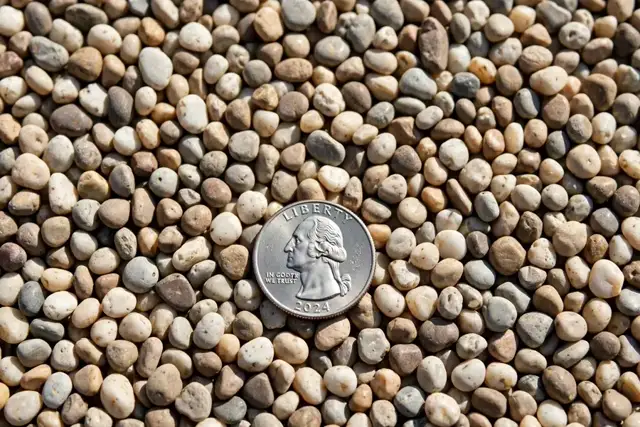
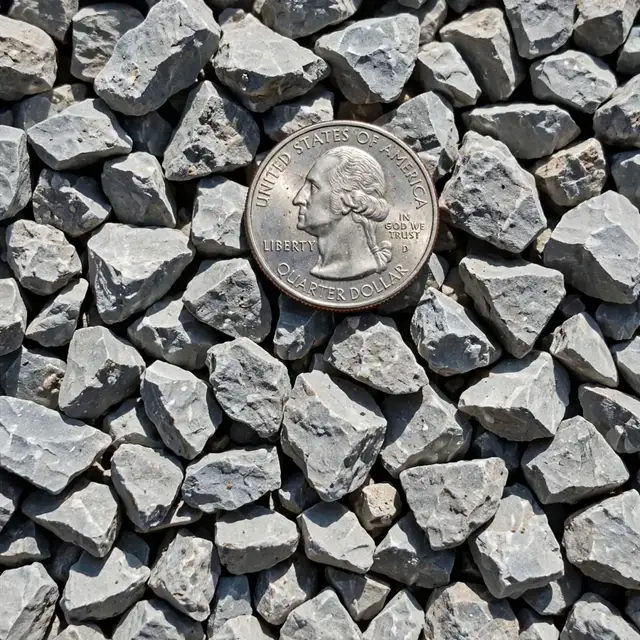
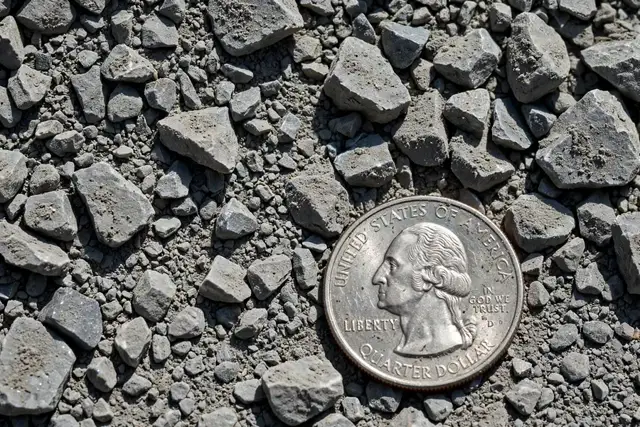
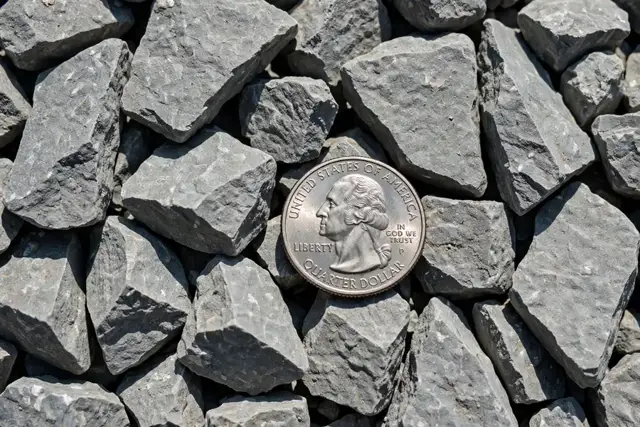
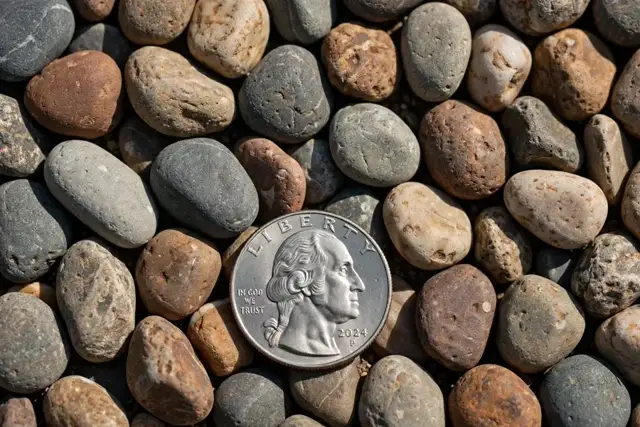
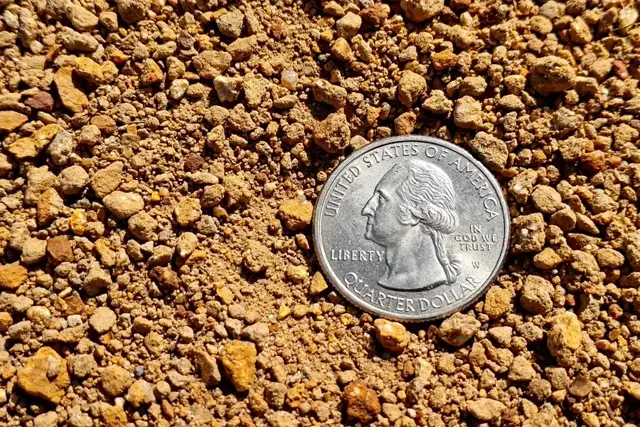
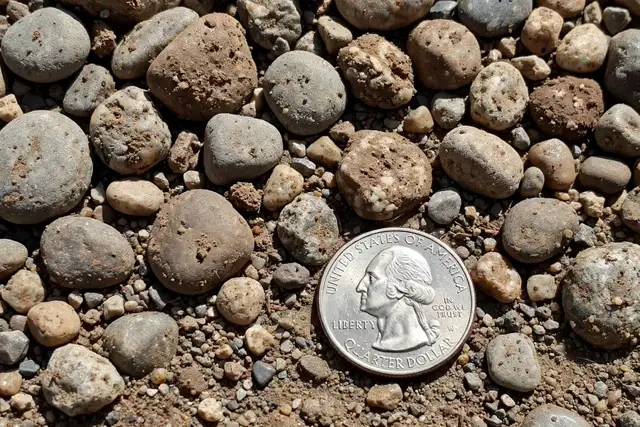
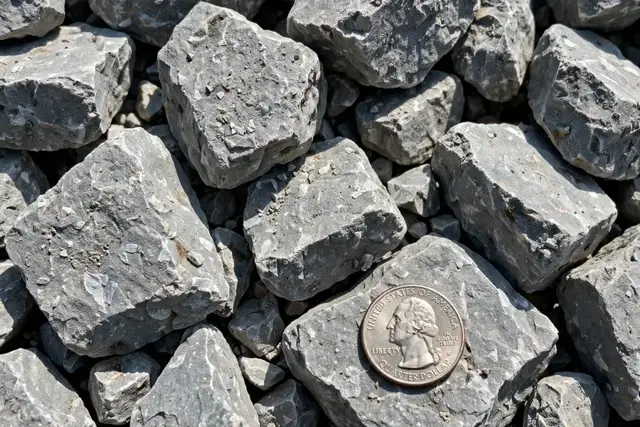
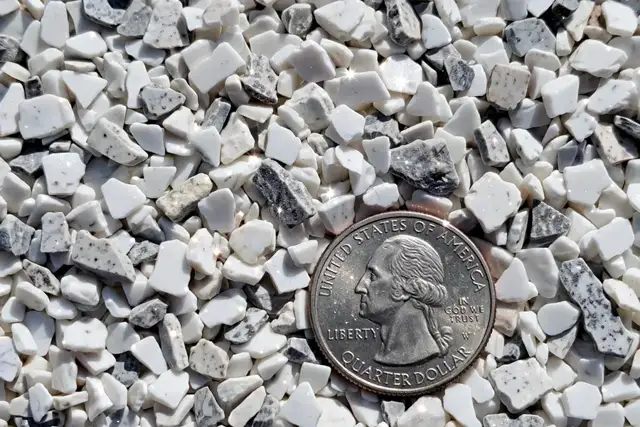
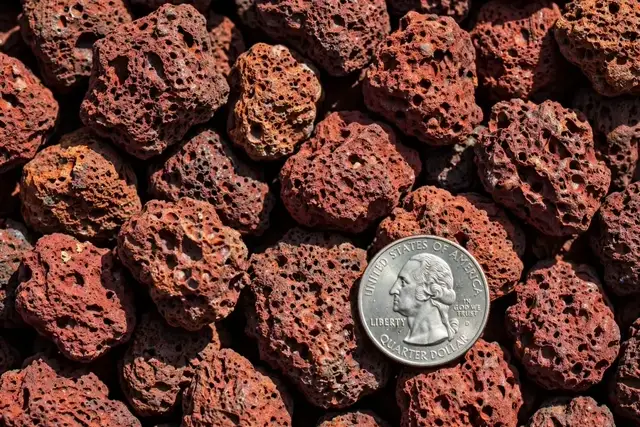
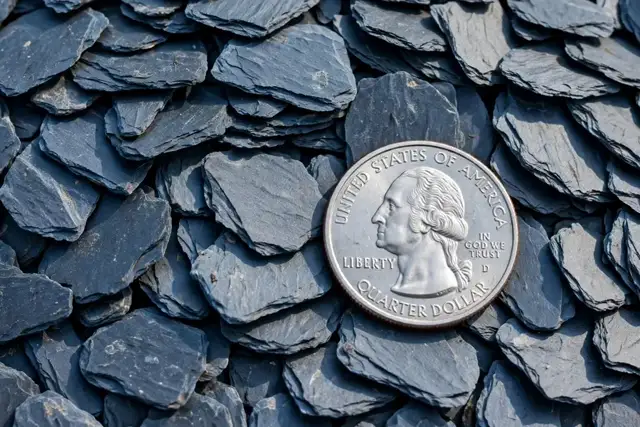
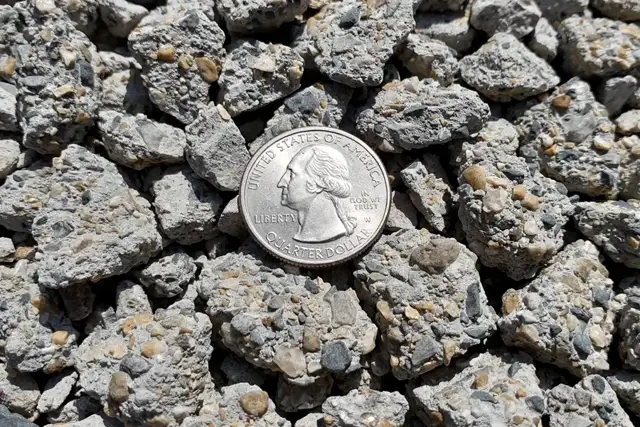
Every type below, photographed with a US quarter (0.955 inches wide) for scale — the fastest way to learn the sizes before you order.
What each type costs
Typical US bulk prices, picked up at the yard — delivery is extra, and prices swing with your distance from the quarry. Bagged stone from a home centre costs several times more per ton; these ranges are for bulk.
| Type | Typical bulk price per ton | Note |
|---|---|---|
| Pea gravel | $30–$60 | Among the cheapest decorative options |
| #57 crushed stone | $25–$50 | The all-rounder — driveways, drains, bases |
| Crusher run / DGA | $18–$35 | Cheapest compacting base material |
| #3 stone | $25–$50 | Large base stone, priced like other crushed stone |
| River rock | $45–$130 | Decorative premium; big sizes cost most |
| Decomposed granite | $35–$70 | Stabilized DG for paths costs more |
| Bank run | $15–$30 | Unscreened fill — the budget option |
| Riprap | $40–$80 | Sold by size class for erosion work |
| Marble chips | Mostly bagged, about $4–$8 per 0.5 cu ft bag | Rarely sold in bulk |
| Lava rock | $80–$215 | Light and porous — you pay for the look |
| Slate chips | Mostly bagged, about $5–$9 per bag | Flat chips for beds and borders |
| Recycled concrete | $15–$30 | Often the cheapest base/fill of all |
Crushed Stone Grades Explained: What Do the Numbers Mean?
Most crushed stone is sold by a number — #57, #3, #8 — and the numbers are not sizes in inches. They are standard size designations (ASTM D448), and as a rough rule, the bigger the number, the smaller the stone. The grades you will actually meet:
- #3 stone: 1–2 inches. The big base stone — first layer on soft ground and deep driveway bases.
- #57 stone: about 3/4 inch, clean and single-sized. The most useful grade in the catalog: driveway surfaces, drainage, French drains, and under concrete.
- #67 stone: similar to #57 but slightly smaller on average. Used the same way where a finer surface is wanted.
- #8 stone: about 3/8 inch. Paver bedding, walkways and pipe bedding where a finer angular stone is needed.
- #89 stone: about 3/8 inch — this is pea gravel’s grade number (see the name translator below).
- #10 / screenings: stone dust up to about 3/8 inch. The fine material that goes under pavers and into blends — never use it where water must drain.
- #411: #57 stone blended with screenings. Behaves like a lighter crusher run: it compacts, but stays more open than DGA.
Other numbered grades in the same system include #1, #4 and #5, alongside #3, #57 and #67. No sizes are listed for those grades here, so check the size with your supplier before ordering.
Two more words on every yard ticket. Clean stone is a single size with the dust removed — it drains freely and never truly compacts. Stone sold “minus” or with fines keeps its dust, and that dust is what lets it pack hard. Same rock, opposite behavior — which is why the fines question matters more than the name. Amounts for each grade are in the crushed stone calculator.
Washed vs unwashed gravel
The same stone is sold two ways, and the difference decides where it belongs. Washed gravel has been rinsed, so the stone is clean with nothing between the pieces. Water runs straight through it, which is why drainage work — French drains, drain fields, around pipes — should always use washed, open-graded stone like clean #57. Unwashed gravel, sold as “minus” (¾-minus, crusher run), keeps its stone dust and fines. Those fines are useless for drainage but gold for compaction: they fill the gaps and lock the layer hard, which is why bases and driveway surfaces use unwashed material. Rule of thumb: if water must pass through it, buy washed; if it must pack down hard, buy minus.
The Gravel Name Translator: Same Stone, Different Names
The fastest way to overpay for gravel — or order the wrong thing — is to shop by name. Quarries name the same material differently from region to region, and a few names mean opposite things in different places. This translator covers the collisions that actually cause wrong orders:
| The name you hear | What it actually is | Where you will hear it |
|---|---|---|
| Crusher run = DGA = quarry process = dirty stone | Crushed stone blended with its own dust; compacts rock-hard. One material, four names. | DGA in the Mid-Atlantic and South; quarry process around New York/New Jersey; crusher run across the South and Midwest |
| Item #4 | A dense base blend much like crusher run, virgin or recycled | New York / New Jersey yards |
| #411 | #57 stone blended with screenings — compacts, but stays more open than DGA | Yards that sell by grade number |
| Pea gravel = #89 | Small rounded natural gravel, 1/4–3/8 inch | #89 is the grade name; pea gravel is the everyday name |
| 3/4 clean | Washed stone of about 3/4 inch with no fines — drains freely, does not compact | Yards that name stone by size |
| 3/4 minus | The same size with the fines left in — compacts hard | The opposite of 3/4 clean. Always check which one a quote means |
| Bank run / pit run | Unprocessed gravel straight from the pit — mixed sizes with sand and clay | Rural pits and yards |
| ABC stone | Aggregate Base Course — a compactable base blend like crusher run | North Carolina and parts of the South |
| Jersey Shore gravel | Rounded, tan-colored decorative gravel | New Jersey / Pennsylvania area |
| Type 1 / Type 2 — warning | These names are NOT standardised. Some Ohio suppliers use Type 1 for clean crushed stone and Type 2 for stone with fines; the UK’s MOT Type 1 is a base blend full of fines — close to the opposite. | Never order by “Type” alone. Ask what is in it: clean, or with fines? |
Decorative Gravels
Pea gravel
Small, rounded stones (1/4–3/8 inch) in mixed earth tones. Pea gravel is soft underfoot and easy to spread, which makes it the standard for paths, patios, play areas and dog runs. Its weakness is the same roundness: it never locks or compacts, so it shifts, needs edging to stay in place, and is a poor choice anywhere a car drives. Amounts and depths are in the pea gravel calculator.
River rock
Larger rounded stones (1–4 inches and up), smooth from natural water wear. River rock is the decorative workhorse for beds, borders, dry creek beds and water features. Being heavier than pea gravel, it stays put better, but it is still a loose surface — keep it out of walking lines, where the big rounded stones are awkward underfoot.
Decomposed granite (DG)
Granite broken down to fine particles — dust to about 3/8 inch. DG spreads like a gritty sand and compacts into a firm, natural-looking surface, which is why it is the classic material for garden paths, patios and bocce courts in dry regions. On paths it is often used with a stabilizer to resist washouts; in wet climates, unstabilized DG can soften and track.
Lava rock
Porous volcanic rock, usually red or black, sold at about 3/4–1½ inches. It is far lighter than ordinary stone for its size, does not break down, and is used as a permanent mulch alternative in hot, dry beds. It is a poor walking surface — the rough, sharp texture is hard on bare feet and paws.
Marble chips
Crushed white and grey marble, about 3/8–3/4 inch. Marble chips give formal beds and accents a bright, clean look that ordinary gravel cannot. Two practical notes: the bright stone reflects a lot of light and heat, and marble is alkaline, so gardeners keep it away from acid-loving plants.
Slate chips
Flat flakes of blue-grey slate, about 1–2 inches across. Because the pieces are flat, they lie down and interlock loosely instead of rolling, which makes slate chips one of the few decorative gravels that works on paths. The color — deep blue-grey, darker when wet — suits modern planting schemes.
Specialty and Utility Gravels
Bank gravel (bank run)
Gravel exactly as it comes out of the pit: unsized, unwashed, mixed with sand and clay. It is cheap and perfectly good as fill or for levelling ground under other layers — and a poor finished surface, because you never quite know what mix you are getting.
Riprap
Large angular chunks, roughly 4–12 inches and up, placed to armor ground against moving water: ditch lines, culvert ends, slopes and shorelines. Riprap works by weight and interlock, not compaction — each stone is too big to be washed away, and together they hold the soil behind them.
Recycled crushed concrete
Demolished concrete crushed to about 3/4 inch with fines. It compacts like crusher run and is often the cheapest base material available — around $26 a ton in many areas. Quality varies by source, so check that it is clean: a good load is just crushed concrete, free of wire, wood and dirt.
Which gravel do I need? Pick your project
How much of it do you need?
Enter your measurements and pick the type — the tool works out cubic yards, tons and bags from the densities on this page.
How to Choose Gravel by Project
- Driveway: build it in layers — a base of crusher run or #3 stone, topped with #57. Depths for each layer are in our gravel depth guide, and the driveway gravel calculator works out each layer's amount.
- Walkway or path: pea gravel for a soft, informal feel, or decomposed granite for a firm one. 2–3 inches deep.
- Patio: pea gravel as the surface over a compacted crusher-run base — or, under pavers, a #411 or crusher-run base with screenings or #8 as the bedding.
- French drain or drainage: clean #57, and nothing with fines in it. Ever.
- Garden beds: pea gravel, river rock, marble chips or lava rock — chosen by look, laid over landscape fabric.
- Erosion control: riprap, sized to the force of the water it faces.
Once the type is chosen, the amount is a five-minute calculation — our guide to how much gravel you need has the formula, the calculator and the order table.
Laying and looking after gravel
Clear and level the area first, then lay landscape fabric where weeds or drainage need it, and fit edging to keep the stone in place. Spread an even layer, and compact it where the type needs it: crushed types lock together when compacted, while rounded pea and river stone shift more.
Afterwards, top up when the layer gets thin, rake it level, and keep drainage clear.
How to lay gravel in 7 steps
- Measure the area. Take the length and width in feet and decide the depth, then run the numbers through the calculator above — or the Gravel Calculator for a full breakdown.
- Clear and level the ground. Remove grass, roots and loose soil, and rake the area flat.
- Dig to the right depth. A walkway or patio needs 2–3 inches. A driveway is built in layers: 6 inches of sub-base, 4 inches of base and 3 inches of surface.
- Lay landscape fabric where weeds or drainage need it. It stops weeds pushing through without blocking water.
- Fit edging first. Edging holds the stone in place so it does not spread onto the lawn or path.
- Build it in layers, never one stone. Use crusher run or #3 as the compacted base, #57 in the middle, and a finer #8 or #411 surface. Spread each layer evenly and compact it where the job needs it.
- Top up and rake. When the layer gets thin, add more stone, rake it level and keep drainage clear.
For depths by project, see How Deep Should Gravel Be? and the Driveway Gravel Calculator.
Gravel Size Chart (Inches and Millimetres)
| Grade or type | Size in inches | Size in millimetres |
|---|---|---|
| #3 stone | 1–2 in | 25–50 mm |
| #57 stone | About 3/4 in | About 19 mm |
| #67 stone | About 5/8–3/4 in | About 16–19 mm |
| #8 and #89 stone | About 3/8 in | About 10 mm |
| Pea gravel | 1/4–3/8 in | 6–10 mm |
| Screenings (#10) | Under 3/8 in | Under 10 mm |
Shopping note for US readers: most American yards sell in inches and grade numbers. If a supplier's page talks in millimetres and "MOT Type 1", you are reading a UK source — the material may be similar, but the names and bag sizes will not match your yard.
Key Takeaways
- Gravel splits into two families: rounded natural gravel (pea gravel, river rock) that never compacts, and angular crushed stone that locks or packs — match the family to the job first.
- The grade numbers are sizes, not quality: #57 (about 3/4 inch, clean) is the most useful all-rounder; crusher run/DGA is the base standard.
- Names change by region — crusher run, DGA, quarry process and Item #4 are the same idea; "Type 1" can mean opposite things. Ask what is in the stone, not what it is called.
- Fines decide behaviour: stone with dust compacts hard (bases), clean stone drains (French drains) and never firms up.
- Decorative types cost more per ton than utility stone, and delivery distance often matters more than the per-ton price.
Frequently Asked Questions
What are the different types of gravel?
The types you will actually be offered are pea gravel, crushed stone in numbered grades (#57, #3, #8), crusher run or DGA for bases, river rock, decomposed granite, and specialty types like riprap, marble chips and lava rock. They split into two families: rounded natural gravel and angular crushed stone.
What's the difference between 3/4 gravel and 3/4 minus gravel?
They are the same size of stone with one difference: the fines. 3/4 clean (or washed) gravel has the stone dust removed, so it stays loose and drains freely. 3/4 minus keeps the dust, which fills the gaps and lets the stone compact into a hard, stable layer.
What does #57 stone mean?
#57 is a standard size grade (ASTM D448), not a brand: clean, angular crushed stone of about 3/4 inch, with the dust screened out. Because it is all one size, it locks together underfoot yet leaves open gaps, which makes it the standard stone for driveway surfaces and French drains.
What is DGA, or crusher run?
DGA — dense-graded aggregate — is crushed stone blended with its own dust and fines, from about 3/4 inch down to powder. The fines fill every gap, so compacted DGA sets almost like a slab. It is sold as crusher run, quarry process or Item #4 depending on the region.
What is the cheapest type of gravel?
Crusher run and recycled crushed concrete are usually the cheapest gravels you can buy — recycled concrete often runs around $26 a ton, and crusher run typically $18–34 a ton. Decorative gravels cost more. Remember delivery can cost more than the stone itself, so the nearest yard often wins.
Is pea gravel good for driveways?
No. Pea gravel's small, rounded stones never lock or compact — under tires they roll, scatter and rut, and they migrate onto lawns and sidewalks. Driveways need angular stone: a crusher run base with #57 on top. Keep pea gravel for paths, patios and play areas, where its soft feel is the point.
What gravel hardens like concrete?
Crusher run (DGA) is the one people mean: its blend of stone and dust compacts so tightly, especially when rolled damp, that the surface sets almost slab-hard — which is why it is the standard driveway and paver base. Decomposed granite with a stabilizer is the path version of the same idea.
What gravel is best for drainage?
Clean #57 stone. It is a single size with the dust screened out, so water flows freely through the gaps between the stones — exactly what a French drain or drainage trench needs. Never use crusher run or any stone with fines for drainage: the fines wash together and clog the gaps.
What is #10 gravel used for?
#10 gravel, also sold as screenings, is stone dust up to about 3/8 inch. It is the fine material that goes under pavers and into blends, where its dust fills the gaps and helps the layer pack down. Never use it where water must drain, because the fines clog the gaps and stop water moving through.
What is type 3 gravel?
Type 3 gravel is usually another name for #3 stone, a large crushed stone; see the #3 profile in the grades section above. If a supplier uses type 3 differently, check the stone size with them before ordering.
Conclusion
Choosing gravel is two decisions: the family (rounded or angular) and the fines (clean or compactable). Get those right and the specific type follows from the project. When you have picked your stone, the gravel calculator turns your measurements into cubic yards, tons and bags for the yard.
Related guides
How Much Gravel Do I Need? · How Deep Should Gravel Be? · How Many Tons in a Cubic Yard? · Gravel Calculator · Driveway Gravel Calculator