
By the WriteFlux Team · Last updated: October 23, 2026
This crushed stone calculator turns your length, width and depth into cubic yards, cubic feet, tons and truck loads. Enter your measurements in feet and inches, pick a US stone grade, and get an instant order quantity — imperial first, with a metric toggle on the calculator for anyone working in metres.
Crushed Stone Calculator
Quick Answer — How much crushed stone do I need? Multiply length × width in feet by depth in inches, then divide by 324 for cubic yards, and multiply by the density: crusher run 1.50 tons per cubic yard, #57 stone 1.40. A 12 ft × 50 ft driveway at 4 inches of crusher run needs 7.41 cubic yards, about 11.11 tons. Use the calculator above for your exact measurements.
Related guides: Driveway Gravel Calculator · Gravel Calculator · Types of Gravel
How to use the calculator
- Measure your area in feet — length and width in feet, depth in inches. Use 4 to 6 in for a driveway base, 4 in under a slab, or 3 in for a surface layer.
- Pick your grade. Each preset uses a typical weight in short tons per cubic yard, which is how US suppliers sell crushed stone.
- Choose a wastage and extra allowance — None, 10% or 20% — add a price per ton if you want a cost estimate, then press Calculate.
What is crushed stone?
Crushed stone is solid rock — commonly limestone, granite or trap rock — that is quarried, blasted or dug from a deposit, then machine-crushed and screened into graded sizes. Screening separates the pieces so a named grade falls inside a known size range, from coarse #3 stone down to fine screenings. Because every piece has been fractured, it has sharp, angular faces, and those faces bite into each other and lock together under load and compaction.
That angular shape is the contrast with natural gravel. Gravel is rounded by water and movement over time, so its smooth pieces roll and shift against each other. Rounded gravel has its own jobs — paths, beds and decorative finishes — and our Gravel Calculator covers gravel itself. Crushed stone is the material you choose when a layer must stay put: a driveway base, a drainage trench, or aggregate that has to interlock rather than wander.
Crushed stone by parent rock: why the same yard weighs differently
Limestone, granite and sand-and-gravel sources differ in density, so the same cubic yard can weigh differently from one quarry or material to another. That is why the calculator asks for the grade first: use the grade preset in the tool for your order, and when you are ordering by weight, confirm the tonnage on the supplier’s ticket.
US crushed stone grades — sizes and best uses
US grades are numbered, and the numbers can look backwards at first: the smaller the number, the larger the stone. The table below is the guide this page is built around. Match the grade to the job first, then run the quantity — the wrong grade at the right tonnage is still the wrong order.
| Grade | Typical size | Tons per cu yd | Best for |
|---|---|---|---|
| #3 | 1–2½ in | 1.45 | Driveway sub-base, drainage, erosion control |
| #57 | ½–1 in | 1.40 | Drainage and French drains, driveway surface, concrete mix |
| #8 | ⅜ in | 1.40 | Driveway top layer, paths |
| #21A / DGA | Fines up to ¾ in | 1.95 | Compacted bases under pavers, driveways and slabs — packs rock-hard |
| Crusher run | Mixed sizes + fines | 1.50 | Driveway base — compacts firmly |
| Screenings | ¼ in and down | 1.40 | Paver joints, base levelling, paths, horse arenas |
One row deserves a closer look. Dense grade aggregate — DGA, also sold as #21A in some regions — weighs far more per cubic yard than the open grades: 1.95 tons against 1.40 for #57. Nothing about the rock itself is heavier. DGA contains fines all the way down to dust, and those fines fill every void between the larger pieces, so a cubic yard of DGA holds far more rock and far less air. That is also why it packs rock-hard, and why a ton of DGA covers less area than a ton of #57.
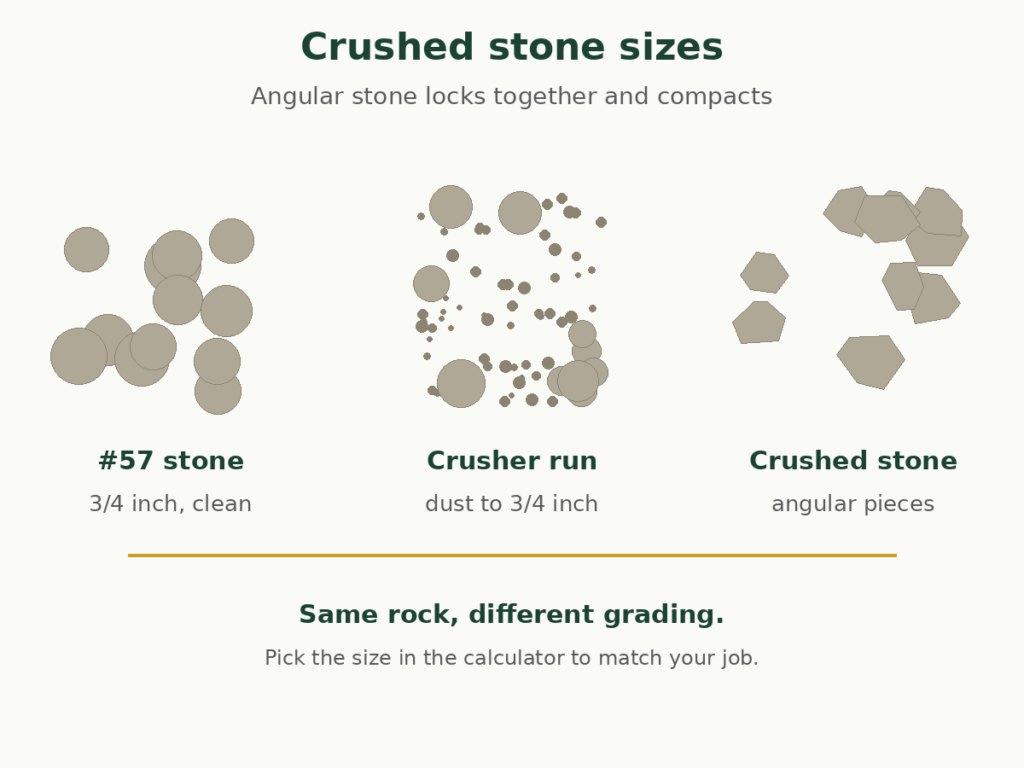
Crushed sizes at a glance: from dust to large stone
- Screenings/dust for levelling and paver bedding
- #8 small stone for paths and drainage topping
- #57 for general driveway/patio/base work
- #3 large stone for drainage and base
- larger stone for heavy base work
The crushed stone formula
Two steps turn your measurements into an order quantity. First find the volume, then convert it to weight with the density of your grade.
Cubic yards = length (ft) × width (ft) × depth (ft) ÷ 27
Tons = cubic yards × density (tons per cu yd)
Depth starts in inches on most jobs, so divide inches by 12 first: 4 in is 0.333 ft. Worked example: a 200 sq ft pad — 20 ft × 10 ft — at 4 in of #57 stone is 20 × 10 × 0.333 = 66.67 cu ft. Divide by 27 for 2.47 cu yd, then multiply by 1.40 tons per cu yd for about 3.46 tons. That is one 10-ton truck load, with room to spare.
A full driveway example, start to finish
Take a typical single driveway, 12 ft wide and 50 ft long, surfaced with crusher run at 4 inches deep:
- Area: 12 × 50 = 600 sq ft
- Volume: 600 × (4 ÷ 12) = 200 cu ft = 7.41 cu yd
- Weight: 7.41 × 1.50 tons per cu yd (crusher run) = 11.11 tons
- With 10% extra for compaction and spillage: 12.22 tons — order about 12.5 tons
- Material cost at typical US prices ($18–$35 per ton for crusher run): roughly $220–$430, plus delivery
- Delivery: 12.5 tons will not fit one standard 10-ton load, so expect two loads or one larger truck
Washed vs unwashed crushed stone
Washed stone has been rinsed clean, so it carries no dust and no fines. Choose washed stone where water must move through the layer — drainage trenches, French drains and behind retaining walls — and where stone becomes concrete aggregate, because clean faces bond properly with cement. An open, washed grade such as #57 leaves voids between its pieces, and those voids are the drain.
Unwashed stone keeps its fines, and that is a feature wherever compaction matters. In crusher run and dense grade aggregate, the fines work like glue: they fill the gaps, bind the larger pieces, and let the layer compact into a firm, almost solid base. The trade-off is drainage — a layer that packs that tight sheds water rather than passing it, so never use a fines-rich grade to fill a drain.
How much does a ton cover?
Coverage per ton depends on density. For #57 stone at 1.40 tons per cu yd, one ton is about 0.71 cu yd, which spreads as follows:
| Depth | Coverage per ton (#57) |
|---|---|
| 3 in | ≈ 77 sq ft |
| 4 in | ≈ 58 sq ft |
| 6 in | ≈ 39 sq ft |
Note that DGA covers less per ton. At 1.95 tons per cu yd, a ton of DGA is a smaller volume — about 0.51 cu yd — so the same ton spreads over a smaller area. Denser is not better or worse; it simply changes the tonnage maths, which is why the calculator asks for the grade before it gives a weight.
How deep should crushed stone be?
| Job | Depth |
|---|---|
| Driveway base | 4–6 in |
| Drainage trench | Fill the trench around the pipe |
| Under a concrete slab | 4 in |
| Surface / top layer | 3 in |
Depths are finished, compacted depths. A driveway is a build, not a single layer: a deep sub-base of #3 on soft ground where it is needed, a compacted base of crusher run or DGA at 4 to 6 in, and a surface layer of #57 or #8 at about 3 in over the top. Run each layer through the calculator separately, with its own grade and depth.
Compaction — why loose stone settles
Stone is delivered loose, full of air gaps between the pieces. Spread it, roll it and drive on it, and those gaps close — the layer settles and ends up thinner than the pile you tipped. Grades with fines compact the most: dense grade aggregate and crusher run can settle noticeably as their fines work into every void, which is exactly what makes them such good bases. Open grades such as #57 settle less, because there is little in them to rearrange.
Be honest about that settlement when you order. The extra allowance in the calculator — 10% for most jobs, 20% for a base that will be heavily compacted — exists to cover it, so the finished depth is the depth you planned. Two ordering facts sit behind the maths. Suppliers sell crushed stone by the ton, weighed on a scale, and a “yard” at the quarry is a volume — a cubic yard — not a weight. The same yard can be 1.40 tons or 1.95 tons depending on grade, so a quote in yards and a quote in tons are only comparable once the grade is named.
Ordering crushed stone and typical prices
Order by the ton figure the calculator gives, and expect it to arrive in 10-ton truck loads — the calculator rounds loads up, because a part load still takes a truck. As a labelled typical US range, and not a quote, bulk crushed stone often runs about $30 to $55 per ton before delivery, with region, grade and haul distance moving the price up or down. Enter the per-ton price your supplier quotes into the calculator for an estimated total cost, and confirm the delivered price — material plus haul — before you book, because delivery can rival the cost of the stone itself on small loads.
Related calculators: Gravel Calculator, Gravel Tonnage Calculator, Driveway Gravel Calculator
Crushed stone is priced by the ton at most US landscape suppliers, typically $25–$50 per ton picked up for common grades like #57, with crusher run and other base materials often $18–$35 per ton. Delivery is extra and is usually charged per load, not per ton, which is why one larger load beats several small ones. Many suppliers have a minimum order of 1–3 tons for delivery; below that, a pickup truck or trailer load from the yard is the cheaper route. Prices swing with your distance from the quarry — the same stone can cost twice as much 100 miles from the source — so the per-ton price box in the calculator above is best filled with a real local quote.
Will it fit in a pickup or a truck?
A cubic yard of crushed stone weighs roughly 1.4 to 1.5 tons, so check the vehicle’s payload rating before loading bulk and never overload it. Bulk delivery suits larger jobs, while bags suit small top-ups.
FAQs
What size crushed stone is best for a driveway?
Use crusher run or dense grade aggregate (DGA) for the compacted base, #57 or #8 stone on top, and #3 stone for a deep sub-base on soft ground. The base does the structural work and packs hard because of its fines, while the top layer gives a clean, free-draining surface.
What is the difference between crushed stone and gravel?
Crushed stone is quarried rock that is machine-crushed, so every piece has angular faces that lock together. Gravel is naturally rounded by water and movement, so it rolls and shifts more easily. They suit different jobs: crushed stone for bases, drainage and driveways, and gravel where a softer, decorative finish matters more.
How many tons of crushed stone are in a cubic yard?
About 1.4 tons for open grades like #57 stone, and up to about 1.95 tons for dense grade aggregate with fines. The grade decides it, because fines fill the voids between stones and add weight without adding volume.
What is #57 stone used for?
#57 stone is used for drainage, French drains, driveway surfaces, concrete aggregate and septic systems. At about 1/2 to 1 inch, with clean, angular pieces and no fines, it drains freely and locks together, which makes it the most versatile grade.
How much crushed stone do I need?
Multiply length in feet by width in feet by depth in feet, then divide by 27 for cubic yards, and multiply by the grade density for tons. Example: a 20 ft by 10 ft pad at 4 in deep is 66.67 cu ft, which is 2.47 cu yd, and at 1.40 tons per cu yd for #57 stone that is 3.46 tons.
How much does a ton of crushed stone cover?
For #57 stone at 1.40 tons per cu yd, one ton is about 0.71 cu yd, so it covers about 77 sq ft at 3 in deep, 58 sq ft at 4 in deep, or 39 sq ft at 6 in deep. Dense grade aggregate covers less per ton because it is denser.
How deep should crushed stone be?
Use 4 to 6 in for a driveway base, fill a drainage trench around the pipe, use 4 in under a concrete slab, and use 3 in for a surface or top layer. Depths are finished, compacted depths, so allow extra when the stone will be compacted.
Should I buy washed or unwashed crushed stone?
Buy washed stone where water must move or concrete must bond, such as drainage and concrete work, because it is clean and has no fines. Buy stone with fines, such as crusher run or dense grade aggregate, where compaction matters, because the fines act as the glue that locks the layer together.
Why does crushed stone settle, and how much extra should I order?
Loose-delivered stone is full of air gaps, so it compacts down as it is spread, rolled and driven on, and dense grades with fines settle the most. Use the extra allowance in the calculator: 10 percent for most jobs and 20 percent where a base will be heavily compacted.
Will it fit in a pickup or a truck?
A cubic yard of crushed stone weighs roughly 1.4 to 1.5 tons, so check the vehicle’s payload rating before loading bulk and never overload it. Bulk delivery suits larger jobs, while bags suit small top-ups.