
By the WriteFlux Team · Last updated: November 5, 2026
Quick Answer
Most gravel projects need 2–3 inches: garden paths and decorative beds take 2–3 inches, and patios need 2 inches of surface gravel over a 4-inch compacted base. Gravel driveways need 6–8 inches in total — a 4-inch crushed-stone base plus 2–4 inches of surface gravel — and 10–12 inches for heavy vehicles. Always compact the base in layers.
Ask five sources how deep gravel should be and you will get five answers — 4 inches, 6 inches, 8 inches, 12 inches — all stated as if they were the only right one. They are usually not disagreeing about gravel. They are answering different questions: surface layer or total build, cars or trucks, firm ground or soft clay. This guide sorts the numbers by project and layer, so each depth has its reason attached.
Gravel Depth by Project: The Complete Chart
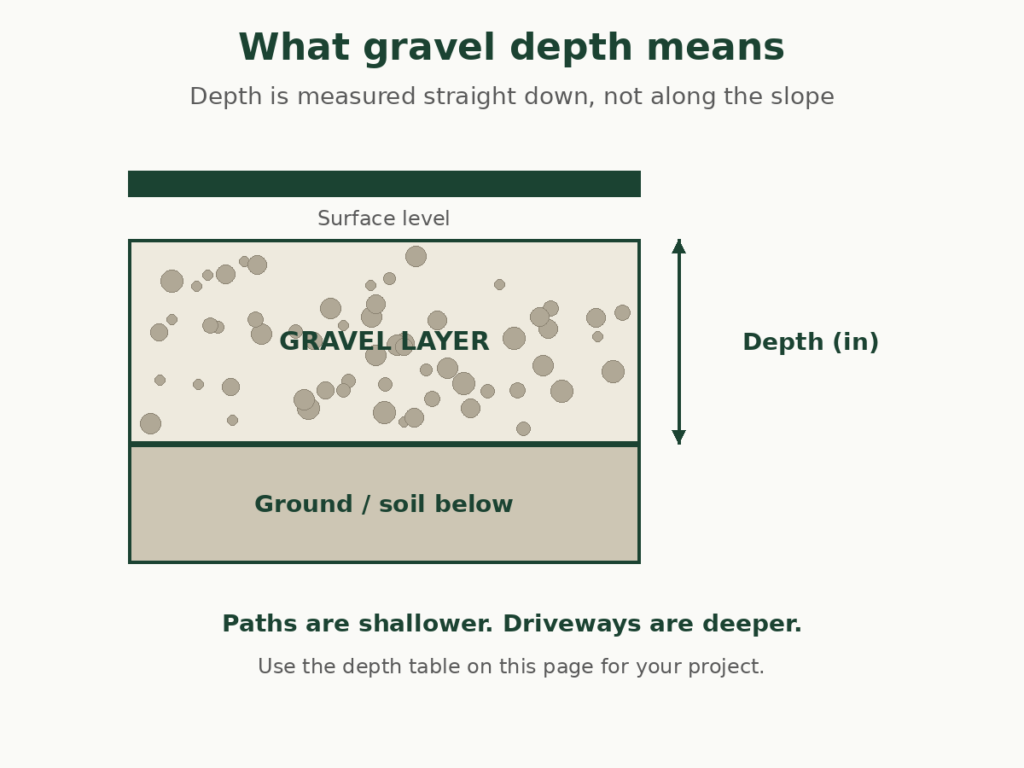
This is the whole answer on one table — base layer, surface layer and total dig for every common project. Depths are the compacted, finished depths; add 10% extra — 10–15% on soft or uneven ground.
| Project | Base layer | Surface layer | Total depth | Depth in millimetres |
|---|---|---|---|---|
| Garden path or walkway | None needed on firm ground; 2 in of crushed stone on soft soil | 2–3 in | 2–3 in (4–5 in with a base) | 51–76 mm (102–127 mm with a base) |
| Decorative bed or border | None — landscape fabric underneath | 2–3 in | 2–3 in | 51–76 mm |
| Patio (loose gravel surface) | 4 in of compacted crushed stone | 2 in | 6 in | 152 mm |
| Play area | 4 in of compacted crushed stone | 2 in of pea gravel | 6 in | 152 mm |
| Paver patio (pedestrian) | 4 in of compacted crushed stone | 1 in of bedding sand, then pavers | 5 in plus the paver | 127 mm plus the paver |
| Driveway (cars, firm soil) | 4 in of crusher run or large crushed stone | 2–4 in of #57 stone | 6–8 in | 152–203 mm |
| Driveway (heavy vehicles, RVs, soft soil) | 6–8 in of large crushed stone | 2–4 in | 10–12 in | 254–305 mm |
| Paver driveway | 6–8 in of compacted crushed stone (up to 12 in on soft or frost-prone ground) | ½–1 in of screenings, then pavers | 7–9 in plus the paver | 178–229 mm plus the paver |
| Shed base | 4–6 in of compacted crushed stone | The base is the surface | 4–6 in | 102–152 mm |
| Under a concrete slab | 4–6 in of compacted crushed stone | — | 4–6 in | 102–152 mm |
| French drain | About 2 in of clean #57 stone under the pipe | At least 2 in of #57 over the pipe; gravel fills the trench | Trench depth — commonly 12 in or more | 305 mm or more |
| Large pebbles and cobbles | None — landscape fabric underneath | 3–4 in | 3–4 in | 76–102 mm |
One rule explains most of the table: the bigger the stone, the deeper its layer has to be. A surface layer should be at least twice the size of its largest stones, or the stones roll and scatter instead of locking together.
| Stone size | Minimum surface depth |
|---|---|
| Small chippings (#57, up to ¾ inch) | 2 inches |
| Pebbles (1–2 inches) | 3 inches |
| Cobbles (2–5 inches) | 4 inches |
How Deep Should Gravel Be for a Driveway?
A gravel driveway is not one layer of gravel — it is a stack, and each layer has a job:
The layer build in 10 seconds: geotextile fabric, base stone, middle layer, surface gravel — each layer compacted before the next goes down.
- Prepared ground. Strip the topsoil, level the subgrade, and lay woven geotextile fabric on soft soil so the stone does not punch down into the mud.
- Base layer: 4 inches of large crushed stone or crusher run, compacted in lifts of 2–3 inches at a time. This layer carries the weight.
- Surface layer: 2–4 inches of smaller stone such as #57. This is the layer you drive and walk on, and the one you top up over the years.
Measure depth after compacting, not before. Loose gravel settles 10–20% as it is compacted and driven on. A layer that measures 4 inches loose can finish near 3¼ inches — which is exactly how driveways end up thinner than planned. Lay each lift 2–3 inches at a time, compact it with a plate compactor (or repeated passes with a vehicle), then measure again before adding the next lift.
That is 6–8 inches in total for a normal car driveway on firm ground. So why do other sources say 4–6 inches, or 10–12? The 4–6 inch figures are usually counting a lighter build — a thin base with a surface layer, or a top-up over an existing base. The 10–12 inch figures are for heavy vehicles, RVs, commercial use or soft clay soil, where the base grows to 6–8 inches. All three can be right; the mistake is quoting any of them without its conditions. If your soil is soft, you park heavy vehicles on it, or winters freeze hard, build toward the deeper end.
Because the layers use different stones in different amounts, our driveway gravel calculator works the stack out layer by layer — base, middle and surface — instead of giving one blended number.
How Deep Should Gravel Be for Patios and Paths?
Paths and walkways: 2–3 inches, total. That is deep enough to cover the ground and lock together, and shallow enough to stay firm underfoot. Past about 3 inches, loose gravel starts to feel like walking on a beach — it shifts, scatters and makes pushing a wheelbarrow hard work. On soft soil, put 2 inches of crushed-stone base under the surface layer rather than making the surface deeper.
Patios: 2 inches of surface gravel over a 4-inch compacted base — 6 inches in total. The best patio builds follow this two-layer system: the angular base stone compacts hard and carries furniture and foot traffic, and the rounded surface stone (often pea gravel) stays thin so chairs sit steady and feet stay comfortable. A patio built as 6 inches of loose gravel with no base is the classic mistake — it feels unstable from the first day. For the amounts in each layer, the pea gravel calculator covers patio and play-area sizes.
How Deep Should Gravel Be for Decorative Beds, Borders and Play Areas?
Beds and borders: 2–3 inches over landscape fabric. Here depth is about coverage, not strength — the gravel only has to hide the fabric and stay put. One inch is too thin (the fabric shows through and stone migrates), and there is no benefit past 3 inches. For purely decorative spots over fabric, installers sometimes go as thin as 1–2 inches, but 2 inches is the safe minimum.
Large pebbles and cobbles: 3–4 inches. Bigger stones need a deeper layer to sit in, or they roll over each other and expose the ground between them — the stone-size table above shows the pattern.
Play areas: build them like a patio — 4 inches of compacted base with 2 inches of pea gravel on top. Pea gravel is the usual surface because the small, rounded stones are kinder underfoot.
How Deep Should Gravel Be for a French Drain?
A French drain is the one project where “depth” means the whole trench. Trenches are commonly dug about 12 inches deep or more (12–18 inches is typical), and gravel fills nearly all of it:
- Bedding: about 2 inches of clean #57 stone in the bottom of the trench.
- The pipe sits on that bedding, with a gentle fall toward the outlet.
- Cover: at least 2 inches of stone over the top of the pipe, then fabric and soil or a surface layer above that.
Use washed, open-graded stone — #57 is the standard — and never crusher run or stone with fines in a drain. The fines wash into the gaps between the stones and clog the very spaces the water is supposed to flow through. How much gravel a trench like this takes, with the pipe’s own volume taken out, is worked through in our guide to how much gravel you need.
How Deep Should Gravel Be Under Sheds, Pavers and Concrete Slabs?
Under anything solid, gravel stops being a surface and becomes the base — and base rules apply:
- Shed base: 4–6 inches of compacted crushed stone, level, and a little larger than the shed so the edges do not crumble away. This is the full depth — the shed floor sits on top.
- Under pavers: 4 inches of compacted base for patios and walkways, 6–8 inches for driveways, then the bedding layer (1 inch of sand for patios, ½–1 inch of screenings for driveways) and the pavers themselves. Frost-prone and soft ground pushes driveway bases toward 12 inches.
- Under a concrete slab: the gravel is a compacted base layer, typically in the same 4–6 inch range, levelled so the slab above it is an even thickness.
Base layers are crushed-stone work, and the grade matters as much as the depth — the crushed stone calculator covers the base grades and their amounts.
How Depth Changes How Much Gravel You Order
Depth is a multiplier: double the depth and you double the material. A 10 × 10 ft patio shows it clearly — the 4-inch base alone needs 1.23 cubic yards of stone, and the 2-inch surface needs another 0.62 cubic yards. Order for the base at surface depth and you would be two-thirds short.
Two habits keep depth orders honest. First, calculate each layer separately, with its own depth and its own material. Second, add 10% extra — 10–15% on soft or uneven ground — compacted depths are what this guide quotes,and loose stone shrinks as it is compacted. For the full set of size-and-depth lookups, see the Order Table in our how much gravel do I need guide, or run your own measurements through the gravel calculator.
What a job takes: area x depth
| Job | Cubic yards | Tons | 50-pound bags |
|---|---|---|---|
| 10 x 10 ft patio at 3 in | 0.93 | About 1.3 | About 52 |
| 10 x 20 ft path at 2 in | 1.23 | About 1.7 | About 69 |
| 20 x 20 ft area at 4 in | 4.94 | About 6.9 | About 277 |
| 40 x 12 ft driveway at 6 in total | 8.89 | About 12.4 | About 498 |
Add 10% extra — 10–15% on soft or uneven ground. Tons use gravel at about 1.4 tons per cubic yard; bags are 50-pound bags.
Driveway example: 40 by 12 feet
A single-car driveway 40 feet long and 12 feet wide, built 6 inches deep in total, needs 40 x 12 x 6 / 324 = 8.89 cubic yards. At about 1.4 tons per cubic yard that is about 12.4 tons, or about 498 fifty-pound bags. With 10% extra for compaction and spillage, order about 13.7 tons.
Geotextile fabric: when it is worth it
On soft or clay soil, a woven geotextile under the base layer is the cheapest insurance a gravel build can have. It keeps the base stone from punching down into the mud and stops soil pumping up into the gravel — the two failures that turn a deep driveway into ruts within a year. Note that this is a structural woven geotextile, not the thin weed fabric sold for flower beds; the two are often confused and are not interchangeable. On firm, well-drained ground you can skip it. Under thin decorative surface gravel it is usually a poor idea: edges work loose, the fabric shows through and tears, and a proper compacted base does more for you.
What Happens If Gravel Is Too Shallow — or Too Deep?
Too shallow: the ground shows through, stones scatter off the edges, weeds take hold, and on driveways the surface punches into the soil and ruts. A too-thin base cannot spread weight, so heavy spots sink first.
Too deep: loose gravel past about 3 inches on a surface never firms up — it shifts under feet and tyres, feels spongy, and makes pushing anything wheeled hard work. You also pay for stone that does no work: on a surface layer, extra depth is waste, not strength. Strength comes from the compacted base, not from piling the surface higher.
Stone size and depth go together
Small stone settles into a firm surface at a shallow depth; big stone needs more depth or it rolls underfoot. Pea gravel and 3/8-inch stone work well at 2 to 3 inches. Standard 3/4-inch crushed stone suits 3 to 4 inches. Larger river stone and cobbles need 3 to 4 inches at least, and they are better as decoration than as a walking surface. Bank gravel is natural pit-run stone in mixed sizes; river stone is rounded and smooth; crushed stone is angular and locks together under weight, which is why it is the usual choice for driveways.
How much 3/4-inch gravel do I need?
Three-quarter-inch is a stone size, not a depth — the quantity still comes from your area and your depth. For a 10 by 10 foot patio at 3 inches deep: 10 x 10 x 3 / 324 = 0.93 cubic yards, about 1.3 tons. For any other size, use the same formula with your own length, width and depth. Add 10% extra — 10–15% on soft or uneven ground.
Topping up a driveway
Gravel migrates, compacts and thins with traffic and rain, so check the driveway each spring. Top up thin spots and ruts with the same stone, rake it level, and compact it. A thin top-up layer is far cheaper than letting the base show through and rebuilding the whole drive.
Key Takeaways
- Paths and decorative beds: 2–3 inches. Patios and play areas: 2 inches of surface gravel over a 4-inch compacted base (6 inches total).
- Driveways: 6–8 inches in total for cars on firm soil — 4 inches of base plus 2–4 inches of surface — and 10–12 inches for heavy vehicles or soft ground.
- The conflicting numbers online (4–6 vs 6–8 vs 10–12 inches) are different builds, not different opinions: always ask whether a figure is the surface, the base, or the total.
- A surface layer should be at least twice as deep as its largest stones; bigger stone needs a deeper layer.
- French drains are filled to the trench depth (commonly 12 inches or more) with clean #57 stone only — never stone with fines.
Why the base layer matters — and what happens if gravel is too thin
The base layer does the structural work. A 4-inch compacted crushed-stone base spreads the weight of cars across the ground and locks together so the surface stone does not shift sideways under tyres. That is why driveways need a base, not just a thick surface layer: surface stone on bare soil ruts and migrates, however deep you pile it.
Too-thin gravel fails in predictable ways. On a driveway, a thin surface over soft ground develops soft spots and ruts where tyres pass, water pools in the low spots instead of draining, and stone gets pushed to the edges until the middle wears bare. One heavy storm can wash a thin, uncompacted layer off a slope entirely.
Top up before it gets that far. When the surface layer wears thin in the wheel lines or bare patches of base start showing through, add fresh surface stone and rake it level — waiting until the base itself breaks up means rebuilding the whole layer instead of topping up the surface.
Work out exactly how much you need for your driveway — base, middle and surface layers included — with our driveway gravel calculator.
Frequently Asked Questions
Is 1 inch of gravel enough?
No, for almost every job. One inch is only acceptable for purely decorative beds over landscape fabric, and even there the fabric tends to show through. Working minimums are 2–3 inches for paths and beds, 2 inches of surface over a 4-inch base for patios, and 6–8 inches total for driveways.
Is 2 inches of gravel enough?
Yes — for the right jobs. Two inches is enough for light garden walkways and decorative beds, and it is the correct surface depth over a compacted base on a patio. It is not enough on its own for driveways, busy paths or patios, which need a compacted base underneath to carry the load.
Can I put gravel directly on soil?
You can, but on anything that carries traffic it usually fails: the stone sinks into the soil, mud works up through it, and weeds follow. The fix is a proper stack — dig out the topsoil, lay fabric on soft ground, compact a crushed-stone base, and only then spread the surface gravel.
Do I need to put sand under gravel?
No. Sand does not belong under a loose gravel surface like a driveway or path — it adds nothing and can wash out. The one exception is under pavers, where a 1-inch layer of bedding sand is screeded on top of the compacted gravel base, never underneath it, to level each paver.
Should I use landscape fabric under gravel?
Under beds and paths, yes — fabric blocks weeds and keeps gravel out of the soil. Under driveways, use woven geotextile, which also stops the base stone punching into soft ground. But fabric is never a substitute for depth: a thin layer of gravel over fabric still sinks, scatters and shows through.
How much gravel do I need for 2 inches deep?
At 2 inches deep, one cubic yard of gravel covers about 162 square feet, and one ton covers about 116 square feet at the standard 1.40 tons per cubic yard. So a 10 × 10 ft area needs 0.62 cubic yards (0.86 tons), plus 10% extra — 10–15% on soft or uneven ground.
How deep should pea gravel be for a patio?
Use 2 inches of pea gravel over a 4-inch compacted crushed-stone base — a 6-inch dig in total. The base does the structural work and keeps the patio firm under chairs and tables, while the pea gravel stays thin enough to walk on comfortably. Deeper loose pea gravel shifts and feels unstable.
What depth of gravel for a French drain?
The gravel fills the whole trench, which is commonly 12 inches deep or more. Bed the pipe on about 2 inches of clean #57 stone, then cover it with at least 2 inches more. Use washed, open-graded stone only — fines and crusher dust clog the gaps the water needs to flow through.
Is 4 inches deep enough for a driveway?
As the total build, no. Four inches works only as a fresh surface layer over a solid existing base, or as a top-up over last year’s gravel. A new driveway needs the full layered build: 6–8 inches in total for cars, 10–12 inches for heavy vehicles or soft clay soil — compacted in lifts.
How much gravel for 4 inches deep?
For 4 inches deep, 1 cubic yard covers 81 square feet, and 1 ton covers about 58 square feet at the standard 1.40 tons per cubic yard. Work it out as length × width × 4 ÷ 324 = cubic yards.
Conclusion
There is no single right depth for gravel — there is a right depth for each project and each layer. Paths and beds need 2–3 inches, patios need a thin surface over a real base, and driveways are a 6–12 inch build depending on load and soil. Once your depths are set, the gravel calculator turns each layer into cubic yards and tons, and the driveway gravel calculator handles the full layered stack for driveways.