
By the WriteFlux Team · Last updated: November 5, 2026
Quick Answer
How many tons in a cubic yard? There is no single answer, because a cubic yard measures space and a ton measures weight. One cubic yard of gravel or crushed stone weighs about 1.4 tons (2,800 lb). Dry topsoil is much lighter at about 1.0 ton, sand is about 1.35 tons, and solid concrete is about 2.0 tons. Use the chart or converter below for your material.
If you are ordering gravel, sand or topsoil, you run into this problem fast: your project is measured in cubic yards, but the supplier sells by the ton. Guess the conversion wrong and you either pay for a second delivery or pay to haul the extra away.
This guide fixes that. It gives you the weight of a cubic yard for 16 common materials, a converter that works in both directions, and the coverage you get from a ton — using the same density figures as our calculators, checked against published sources.
Cubic Yard to Ton Converter (Both Directions)
Pick your material, type an amount, and choose the direction. This is the conversion most charts only give you one way.
Working from an area instead — length, width and depth? Our free gravel tonnage calculator does the full job, including truck loads.
How Many Tons Are in a Cubic Yard of Each Material?
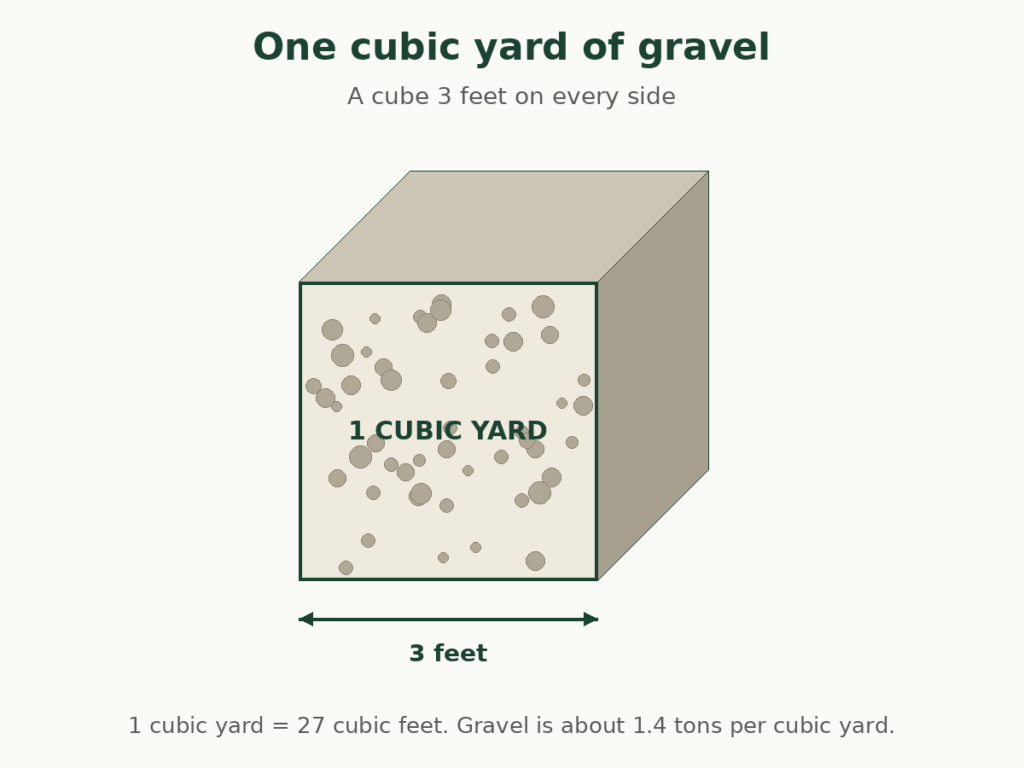
One cubic yard is always 27 cubic feet of space. What changes is the weight packed into that space. Here is the full chart, in both directions:
| Material | Pounds per cubic yard | Tons per cubic yard | Cubic yards per ton |
|---|---|---|---|
| Gravel (general) | 2,800 lb | 1.40 | 0.71 |
| Crushed stone (#57) | 2,800 lb | 1.40 | 0.71 |
| Crusher run | 3,000 lb | 1.50 | 0.67 |
| Pea gravel | 2,600 lb | 1.30 | 0.77 |
| River rock | 2,700 lb | 1.35 | 0.74 |
| Riprap | 3,200 lb | 1.60 | 0.63 |
| ABC stone (dense-graded base) | 3,900 lb | 1.95 | 0.51 |
| Sand (dry) | 2,700 lb | 1.35 | 0.74 |
| Sand (wet) | 3,200 lb | 1.60 | 0.63 |
| Topsoil (dry, loose) | 2,000 lb | 1.00 | 1.00 |
| Topsoil (damp) | 2,500 lb | 1.25 | 0.80 |
| Fill dirt | 2,200 lb | 1.10 | 0.91 |
| Crushed concrete | 2,700 lb | 1.35 | 0.74 |
| Concrete (solid) | 4,050 lb | 2.03 | 0.49 |
| Asphalt | 4,000 lb | 2.00 | 0.50 |
| Bark mulch | 500 lb | 0.25 | 4.00 |
Two figures on this page can look inconsistent until the condition is stated. Dry, loose topsoil is about 1.00 ton per cubic yard; screened topsoil, which is denser, is about 1.15 — our Topsoil Calculator uses the screened figure. Dry sand runs 1.35–1.43 tons per cubic yard depending on type: mason and play sand at the bottom of that range, washed and concrete sand at the top. Pea gravel is 1.30 tons per cubic yard throughout this site.
These are typical loose densities — the standard figures suppliers and published references use. Real loads vary with rock type, stone size and moisture, easily by 10% either way. If your yard quotes its own conversion factor, use theirs for the order and this chart for planning and checking quotes.
How Many Tons Are in a Cubic Yard of Gravel?
For gravel, the honest answer is a range: about 1.3 to 1.5 tons per cubic yard, with 1.4 as the working figure for most jobs. The type of gravel moves the number:
- Crusher run: 1.50 tons — the heaviest common gravel, because the fine dust fills the gaps between stones.
- Crushed stone #57 and general gravel: 1.40 tons — clean, single-size stone with air gaps between the pieces.
- Pea gravel: about 1.30 tons (sources range 1.25–1.40) — small, rounded stones pack a little looser.
- River rock: 1.35 tons — rounded like pea gravel, in larger sizes.
- Riprap: 1.60 tons — big, dense chunks used for erosion control.
Why the spread? Weight per yard depends on the rock itself (limestone is lighter than granite), the size mix, and how much water the pile is holding. A load weighed after heavy rain can run noticeably heavier than the same pile in a dry week — one more reason to treat every figure here as a close estimate, not a promise.
For driveway and path projects, our gravel calculator and crushed stone calculator apply these same densities to your measurements.
How Do You Convert Cubic Yards to Tons?
The formula is one line:
Tons = cubic yards × tons per cubic yard (from the chart)
Two examples, using gravel at 1.40:
- 10 cubic yards of gravel: 10 × 1.40 = 14.0 tons
- 12 cubic yards of gravel: 12 × 1.40 = 16.8 tons
And if you are starting from measurements rather than a yardage figure, get the cubic yards first: length (ft) × width (ft) × depth (ft), divided by 27. A 40 × 12 ft driveway at 4 inches deep is 480 sq ft × 0.33 ft = 160 cubic feet, which is 5.93 cubic yards — about 8.3 tons of #57 stone. Add 5–10% extra for compaction and uneven ground before you order.
How Do You Convert Tons Back to Cubic Yards?
Just run the formula in reverse:
Cubic yards = tons ÷ tons per cubic yard
- 20 tons of gravel: 20 ÷ 1.40 = 14.3 cubic yards
- 5 tons of gravel: 5 ÷ 1.40 = 3.6 cubic yards
- 1 ton of gravel: 1 ÷ 1.40 = 0.71 cubic yards
This is the direction most charts skip, and it matters in practice: suppliers quote and deliver in tons, so the reverse conversion is how you check whether the load that just arrived actually covers your project. It is also why a ton and a cubic yard are not the same thing — one ton of gravel fills only about seven-tenths of a cubic yard, while one ton of dry topsoil fills a full yard.
Why Do Some Charts Say Topsoil Weighs 1.35 Tons per Cubic Yard?
You may have seen 1.35 tons (2,700 lb) quoted for a cubic yard of topsoil — even in search results' AI summaries. For dry topsoil, that figure is too heavy. The US Army Corps of Engineers' field manual FM 5-434 puts earth at roughly 1,900–2,200 lb per cubic yard, and supplier references put dry, loose topsoil at about 2,000 lb — 1.0 ton per cubic yard.
The 1.35 figure is not invented: it is roughly right for damp soil, and it is exactly the right figure for dry sand, so it is easy to see how it gets copied onto topsoil. The practical rule: use 1.0 ton per yard for dry topsoil, 1.25 if it is damp, and expect a rain-soaked load to weigh more still. More on soil weights in our topsoil calculator.
How Much Does One Ton of Gravel Cover?
Weight converts to coverage just as easily. At 1.40 tons per cubic yard, one ton of gravel covers:
| Depth | Coverage per ton of gravel |
|---|---|
| 1 inch | 231 sq ft |
| 2 inches | 116 sq ft |
| 3 inches | 77 sq ft |
| 4 inches | 58 sq ft |
| 6 inches | 39 sq ft |
What does a ton actually look like? Picture a loose pile roughly 4–5 feet across and about 1.5–2 feet high at the peak — that is your 0.71 cubic yards. Spread at a typical 2-inch depth, that same ton covers an area about the size of a 10 × 11.5 ft parking space.
What is 100 cubic yards in tons?
For big orders the same maths scales up. Multiply the cubic yards by the tons per yard for your material. Gravel and crushed stone run about 1.4 tons per cubic yard, so 100 cubic yards is about 140 tons. Sand runs about 1.35 tons per cubic yard, so 100 cubic yards is about 135 tons. Topsoil and fill dirt run about 1.0 to 1.3 tons per cubic yard, so 100 cubic yards is about 100 to 130 tons. For an exact figure for your own material, use the converter above, then add 10% extra for compaction and spillage.
Should You Order by the Ton or by the Cubic Yard?
Most US landscape yards and quarries sell gravel, stone and sand by the ton, weighed on a scale as the truck leaves. Some yards sell by the cubic yard instead, loading with a bucket of known volume. Neither is better — but the two are only comparable once you convert, which is exactly what the chart above is for.
Two things to ask before you order. First, which unit is the quote in, and what conversion factor is the yard using? Second, is the material wet? Water adds real weight, and on a by-the-ton ticket you pay for it. For sand especially, our sand calculator and the wet-sand row in the chart will keep a quote honest. Mulch is the opposite case — it is almost always sold by the yard, because at about 0.25 tons per yard the weight barely matters; see the mulch calculator for bag and yard figures.
Key Takeaways
- A cubic yard is space (27 cubic feet); a ton is weight (2,000 lb). The bridge between them is the material's density.
- Most gravel and crushed stone: about 1.4 tons per cubic yard (range 1.3–1.5 by type).
- Dry topsoil is about 1.0 ton per yard — not the 1.35 tons some charts claim; that figure belongs to damp soil or dry sand.
- Convert both ways: tons = yards × density, and yards = tons ÷ density. One ton of gravel is 0.71 cubic yards and covers about 116 sq ft at 2 inches deep.
- Figures are typical loose densities and can shift about 10% with rock type and moisture — confirm your supplier's conversion factor when you order.
Why you often see "1 cubic yard = 1.5 tons"
You will often see 1 cubic yard quoted as 1.5 tons. That is a rough average across common aggregates, not a figure for one material. On this page's chart, crusher run is 1.50 tons per cubic yard, general gravel is 1.40, and wet sand is 1.60 — the 1.5-ton shortcut sits between them, which is why it gets repeated.
Ranges work the same way. Asphalt is often quoted at 1.8 to 2.3 tons per cubic yard; the chart's single figure of 2.00 sits inside that range. Solid concrete is often quoted at 2.0 to 2.2 tons; the chart uses 2.03, also inside that range. A single figure is easier to calculate with; a range is honest about how much the same material can vary with mix, moisture and compaction.
So use the chart's per-material figure when you order, and treat 1.5 tons as a quick estimate only — close enough for a rough guess, not exact enough for an order.
Frequently Asked Questions
How many tons of gravel are in a cubic yard?
Most gravel weighs about 1.4 tons per cubic yard (2,800 lb), and 1.4 is the figure to plan with. The type matters: crusher run is heavier at about 1.5 tons because its fines fill the gaps, while pea gravel and river rock are lighter at about 1.35 tons.
How many cubic yards are in a ton of gravel?
One ton of gravel is about 0.71 cubic yards — just divide 1 by the density of 1.40 tons per cubic yard. Crusher run gives you a little less space per ton, about 0.67 cubic yards, and pea gravel a little more, about 0.74 cubic yards per ton.
Is 1 ton the same as 1 cubic yard?
No. A ton measures weight — 2,000 pounds — while a cubic yard measures space, 27 cubic feet. They only match when a material weighs exactly 2,000 pounds per cubic yard, which is true of dry topsoil. Gravel is about 40% heavier per yard, at roughly 1.4 tons.
How many yards is 20 tons of gravel?
Twenty tons of gravel is about 14.3 cubic yards: divide the tons by 1.40 tons per cubic yard. The exact figure depends on the type — roughly 13.3 cubic yards for dense crusher run and up to about 14.8 cubic yards for lighter pea gravel at 1.35 tons per yard.
How much does a cubic yard of gravel weigh?
A cubic yard of gravel weighs about 2,800 pounds, or 1.4 tons, for most crushed stone and general gravel. The full range across types is roughly 2,500 to 3,000 pounds: pea gravel sits near the light end, and crusher run, with its packing fines, reaches about 3,000 pounds.
How many tons are in 10 cubic yards of gravel?
Ten cubic yards of gravel weigh about 14 tons, using the standard 1.40 tons per cubic yard. Scale it directly: 5 cubic yards are about 7 tons, and 12 cubic yards are about 16.8 tons. If your gravel is crusher run at 1.50, 10 yards weigh 15 tons.
What does 1 ton of gravel look like?
One ton of gravel is about 0.71 cubic yards — a loose pile roughly 4 to 5 feet across and 1.5 to 2 feet high at the peak. Spread out, it covers about 231 square feet at 1 inch deep, 116 square feet at 2 inches, or 58 at 4 inches.
What is the difference between a ton and a tonne?
A US ton, also called a short ton, is 2,000 pounds. A tonne is the metric unit, 1,000 kilograms or about 2,205 pounds — roughly 10% heavier. American quarries and landscape yards sell by the short ton, so check the unit if you are comparing with metric sources. A different 'ton' you may meet: the freight (register) ton. It is a shipping volume unit — 40 cubic feet of cargo space — not a weight. If a converter talks about register tons, it is not talking about the tons your gravel supplier means.
How many tons is 100 cubic yards of gravel?
About 140 tons. Gravel and crushed stone weigh about 1.4 tons per cubic yard, so 100 cubic yards comes to roughly 140 tons. Sand is about 135 tons for the same volume, and topsoil is about 100 to 130 tons. Always confirm the density with your supplier and add 10% extra for compaction and spillage.
How many tons of gravel do I need for a driveway?
A standard 30 by 12 foot driveway with a 6-inch sub-base, a 4-inch base and a 3-inch surface needs about 14.44 cubic yards, about 21 tons in total. For the full driveway worked example — area, depth and bags — see how much gravel you need.
Conclusion
Converting between cubic yards and tons is one multiplication — once you use the right density for your material. Plan gravel jobs at 1.4 tons per cubic yard, lighter materials like dry topsoil at 1.0, and check any quote that uses a very different factor. When you are ready to size a real project, the gravel tonnage calculator turns your length, width and depth straight into cubic yards, tons and truck loads.